When Doing the Wrong Thing is Right
The time I threw away some perfectly good onions

My oldest sister’s birthday is today, so I thought it would be timely to reflect on some ethical issues that arose during a time when she needed some extra care.
In October of 2023, my oldest sister, Diana, was diagnosed with breast cancer, just weeks after the birth of her second child. This was already a harrowing time for my family. My second oldest sister, Kelley, had also given birth to her first child around the same time as Diana, which was nearly six weeks prior to her due date. She suffered from preeclampsia and a postpartum hemorrhage, and experienced a number of medical issues in the year that followed. Just a few months earlier, I finished up radiation treatment for early stage lymphoma. And our youngest sister, Haley, was in the throes of wedding planning while still serving as an active duty Army helicopter pilot.
We were all in desperate need of support, but Diana’s cancer diagnosis was imminently life threatening. She had the most aggressive type of breast cancer and began chemotherapy almost immediately to shrink the tumor prior to undergoing a double mastectomy. Our family jumped into action helping my sister and her husband plan both treatment and childcare coverage for an indeterminate amount of time. We all live in different states, so this was a very complicated task, but we made it work.1 Their community of friends and neighbors rallied behind them as well, for which I will be forever grateful.
It is a powerful thing to watch someone you love endure hours of painful chemotherapy treatment. My sister is a war hero, too: she deployed twice to Afghanistan during her time in the Army. I believed she was tough, but I really had no idea until I saw her endure the poison entering her body to kill the cancer, the sharp pain of the icy gloves and slippers she wore during treatment to prevent peripheral neuropathy, and the frozen helmet meant to prevent hair loss and preserve some of her dignity. She wasn’t just tough. She was indestructible.
She made me breakfast that morning, by the way. My sister made me breakfast before I drove her to her chemotherapy appointment.
That may be what turned me away from more traditional ways of ethical thinking like consequentialism and duty ethics. I enjoy teaching those systems of thought, but I resonate more with virtue ethics and care ethics. I’ve written a bit about care ethics in the context of the show Survivor, but it’s relevant here too.
It’s really hard to know what the right thing to do is when everything seems to be going wrong, but I find that thinking about things in terms of care and relationships helps me decide. Let me share one of my favorite memories of this time to help illustrate this difficulty.
Several months into my sister’s cancer treatment, I returned to help during my spring break. She did not have chemotherapy treatment that week, but was very depleted from everything she had already done. Both she and her husband were still working, and her four-year-old and infant sons still needed parenting. The meal trains continued thanks to local friends and neighbors.
One evening, a very kind woman dropped off a lot of pre-prepared meals that she had made and assembled herself. It was so smart, too, because she labeled everything and had them in microwaveable containers. She also stored any sauces in separate containers because she knew they had a young child, and young children are often suspicious of anything that isn’t a dinosaur-shaped chicken nugget and whatever ketchup vintage they have come to prefer during their short existence.
This is a beautiful example of care ethics in action. But to understand how care ethics work, you need a definition of care. I really like Berenice Fisher and Joan Tronto’s definition, which is:
...a species activity that includes everything that we do to maintain, continue, and repair our ‘world’ so that we can live in it as well as possible. That world includes our bodies, our selves, and our environment, all of which we seek to interweave in a complex, life-sustaining web2
In a 1998 article, Tronto expands on this work and includes a table of questions that can guide caring judgments. It begins with four sets of questions that arise from the elements, or phases, of care:
Attentiveness. What care is necessary? Are there basic human needs? What types of care now exist; how adequate are they? Who gets to articulate the nature of needs and to say what and how which problems should be cared about?
Responsibility. Who should be responsible for meeting the needs for care that do exist? How can and should such responsibility be fixed? Why?
Competence. Who actually are the care-givers? How well do they do their work? What conflicts exist between them and care receivers? What resources do caregivers need in order to care competently? Who pays attention to changes in care receivers’ needs?
Responsiveness. How do care receivers respond to the care that they are given? How well does the care process, as it exists, meet their needs? If their needs conflict with one another, who resolves these conflicts?3
As caregivers, we should be attentive. That means we need to recognize what care is necessary. We also need to identify who is responsible for giving that care. But this isn’t enough: we need to be competent caregivers if we are the ones responsible. The example I give to explain this to my students is when we want to care for a sick friend.
Say your friend has a sore throat and hasn’t been able to leave their room, so you decide to bring them some soup. You have been attentive and identified a need, and decide you hold some responsibility for giving that care as their friend. Now say you bring them the soup but you spill half of it on their floor while trying to serve it to them. Or you brought them chicken broth, but they’re vegetarian. Or you brought them a soup with shrimp, but they’re allergic to shellfish.
It’s the thought that counts, right? NOPE. Not in care ethics! I actually love this, because it highlights the importance of the first dimension: attentiveness. I don’t fault you for tripping and spilling the soup (accidents happen), but delivering competent care requires you to attend to specific needs. You should probably know (or ask) whether your friend has dietary restrictions or allergies before bringing food.
I’m not saying you’re a Bad Person™ if you’ve done something like this. We all have. But I like that there’s a kind of built-in humility when it comes to care ethics: we don’t know exactly what others need. We have to learn how to ask the right questions and how to pay attention. “Tell me what you need” is antithetical to this mode of ethical living. Certainly we can’t divine everything someone needs without asking questions, but this is something we can work to improve on over time. Part of the care is the mental labor it takes to figure out what is needed.
This neighbor of my sister and brother-in-law’s was attending to their needs, taking responsibility, and caring competently. For the most part. There’s one grocery bag in this delivery of kindness that I haven’t mentioned yet: fresh produce.
Not only were there the thoughtfully prepared and portioned meals, but she also brought fresh produce: a massive bag of green beans, some onions, and a few heads of broccoli. I knew that if I didn’t get these things prepped for use then they would likely just rot in the bag. So at this point I am in caregiving mode. I am paying attention and taking responsibility, and trying to act competently based on what I know about my sister and her family’s needs.
We came inside from receiving the provisions and my sister was immediately overwhelmed. I told her to sit down at the kitchen table while I figured out how to rearrange the fridge and freezer to accommodate everything. I gave Diana the bag of green beans and asked her to start snapping off the ends so I could wash them and put them in containers to be steamed or sauteed later. I started chopping up the broccoli for the same purpose.
She started complaining about the task pretty quickly: “Why do people do this? Don’t they know you can buy these pre-snapped?” I started laughing but was determined that we finish our tasks.
The pile of green beans in front of my petite sister grew comically large as she continued to snap off their ends. Suddenly I realized that none of us were going to eat all of these green beans. There was no way. Not with everything else we already had. I had already gone grocery shopping that week and prepped a bunch of other fresh foods per my brother-in-law’s specifications.4
I turned to her and I told her to stop. We had enough green beans. She let out a sigh of relief. I took the bag of remaining unsnapped beans and tossed it in the trash can. She gasped, “Adrienne!” I said, “There’s no way we can eat all of these green beans before they go bad. It’s okay.” She conceded that I was right.
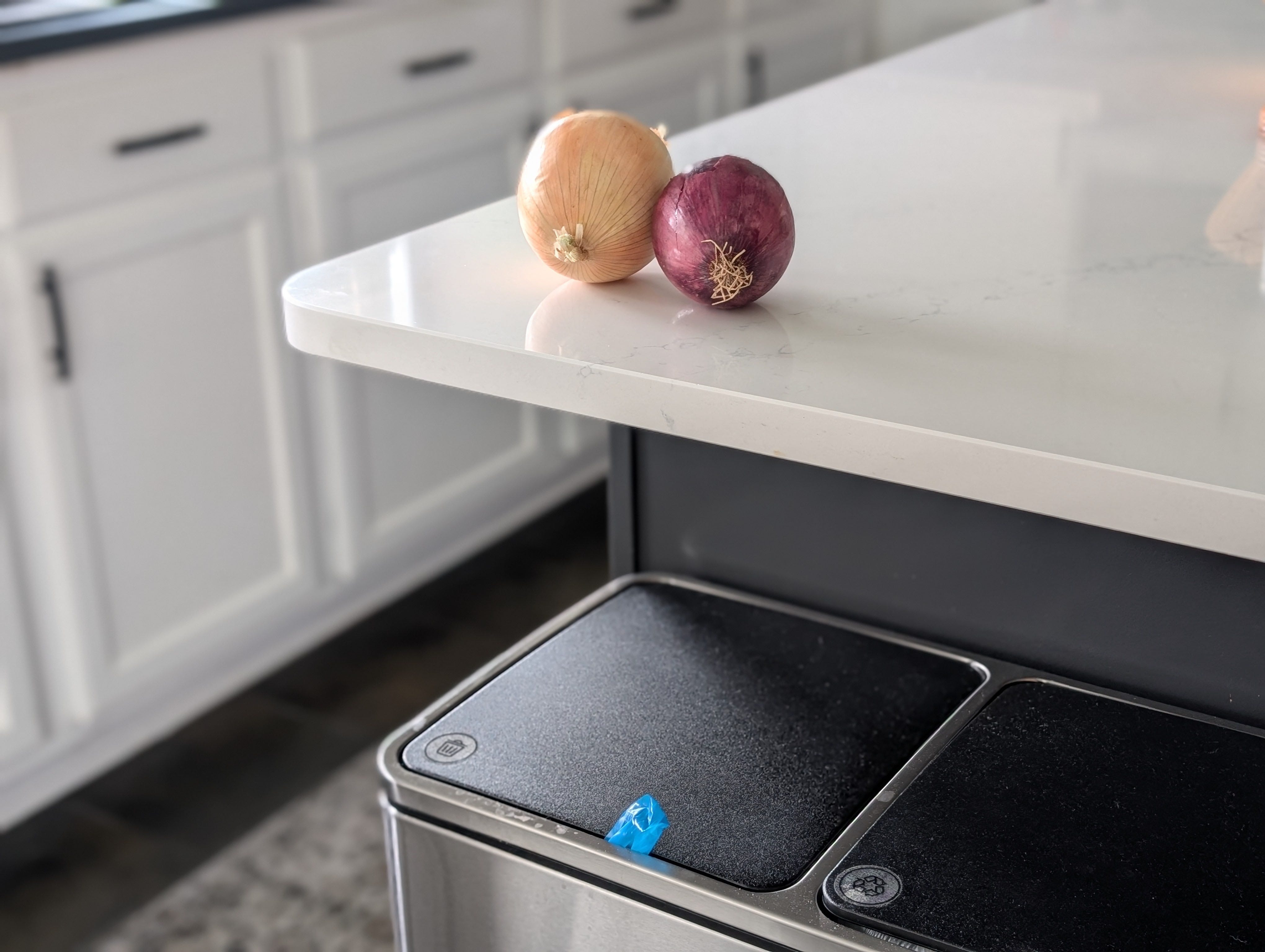
But there were still onions on the counter. I have never seen my sister chop an onion.5 I looked at Diana and asked, “Will anyone who comes into this house in the next couple of weeks chop these onions, or are they more likely to rot on the counter until someone throws them away?” She nodded, as if toward the latter half of the question, “That one.”
“Do you want me to make these go away now?” I asked her. She paused, then nodded.
“Close your eyes,” I said.
“What are you going to do?!” she asked.
“Just do it!” I insisted.
She did, and I pulled the trash can back out of the cupboard and rolled the onions off the counter and into the bin. They landed with a couple of dull thunks as they joined the green beans. My sister, eyes still squeezed shut, started to giggle. She has the most delightful giggle. I would throw away a thousand perfectly good onions to make sure I could hear Diana’s giggle for the rest of my life.
“Did you…?” She asked, opening her eyes.
“Don’t worry about it. I’ll take the trash out to the big trash can now. It will be like they were never here, and nobody ever has to know.”
“Thank you, Ad, really.”
You’re welcome, Di Di. I’m sorry I’m telling people now, but I don’t think you’ll mind.
As folks read this, they might be wondering where the “wrong thing” is. I really don’t like wasting food like that. I’m fairly certain it’s wrong. Certainly I could have researched food pantries in the area and taken the excess to one the following day. But I really don’t think that was feasible for me, based on other needs I had to attend to, including my own.
I recently wrote about different types of value and how moral goodness can sometimes conflict with prudential goodness. That is, the right or good thing to do is not always good for the individual doing it. This framework privileges a type of ethical thinking that can’t fully capture the complexities of our decisions in everyday life. It has us thinking about individuals and their actions, rather than caregivers and care receivers who exist in networks of relationships.
If we think of this just in terms of me and my actions, it looks like this: It is wrong to throw away food. The morally right thing to do would be to donate that food. But doing the right thing was going to tax me enormously, given everything else I needed to do. So if we privilege what was in my best interests in this situation, it was mostly certainly to toss the onions. But, according to some ethical theories, that doesn’t make the action morally right. It may justify it, but it doesn’t transform it into a moral good.
But I think looking at this situation in terms of individual actions is a bit short-sighted. You see, this wasn’t just about me and my relationship with my good and The Good. It was about my sister, the lady who brought the food, my brother-in-law, my nephews, my dog back at my Airbnb, me, and everyone else in this network of relationships.
So if we evaluate this situation in terms of the elements of care that Tronto suggests, the right thing to do becomes more apparent.
First, I paid attention to the needs of my sister and her family. Someone needed to sort and store the food. This required knowledge of their kitchen, their current grocery supplies, and their individual preferences and dietary restrictions. I had all of this.
Second, I took responsibility for the care that was needed. I took responsibility because I was present and because I had the appropriate knowledge of their care needs.
Third, I delivered competent care. I knew how to sort and re-organize and chop and rinse and so on and so forth. And I knew that throwing some things away was part of that care.
Finally, there is responsiveness. How well does the care given meet their needs? I like to think I met my sister’s needs perfectly in that moment.
I haven’t convinced myself that throwing away those green beans and onions was a good thing to do, when taken at face value. But I do know that looking at things in the context of care meant that what I did was right.
By the way, happy birthday, Diana. I promise to never buy you fresh produce (unless the need arises).
Since I was still in graduate school at the time, I had some schedule flexibility. I had very few classes I was still taking, and my teaching load was blessedly light. I know there were some things I missed and fell short on, but I will never regret being there for my sister when she needed me.
p. 40, Berenice Fisher & Joan Tronto, 1990. “Towards a Feminist Theory of Care.”
p. 18, Joan Tronto, 1998. “An Ethic of Care.”
My brother-in-law is king of ensuring fresh berries and sliced fruits are available at their house. I’ve learned this is an essential skill for fathers, since small children are apparently obsessed with berries. The obsession is beginning to strain parents’ wallets, too.
I assume my brother-in-law has, but I had already taken over his cutting board duties for the time I was there so I didn’t want to leave that for him.
First of all, I am very sorry that you had to go through this as a family and hope everybody is OK now.
That being said, this is one of the most thought-provoking Substack posts I have ever read. I do agree with your inclination to say, at face value throwing away the onions was not right, although it was right in your context—as I think your situation was definitely not the same as not having any other responsibilities and throwing away the onions anyway (in that case it would be wrong to send them to trash both at face value and in the individual context).
The first line of thought I had when I read this was (I read your other post on values too): Maybe what is morally good is what is in the interest of the individual (so in this way what is morally good is always to be contextualized in relation to the person’s interests).
Well, that is a big claim and I don’t think I want to argue that way. I can think of million things that might be in an individual’s best interest that are just not morally good (lying in court when accused of a crime in order to avoid a life-sentence, for example).
Maybe instead of saying morally good and the individual interest conflict, one might argue that there are certain individual interests that justify deviation from morally good (in this case it is not simply the morally good thing anymore-lex specials derogat legi generali ☺️).
So, what might differentiate your case from lying in court might be something like this: In your case, your throwing away the onions justifies deviation from the morally good, whereas in the second case of lying, it doesn’t. Then, what is it that might justify such a deviation? I think that is something like the moral good that personal interest is trying to serve. You didn’t throw away the onions just because you were lazy. You cared for yourself and your sister. Then I think the decision you made was that these acts of care referred to a higher moral value behind them, when compared to not throwing away the onions. It must be this higher moral value that justifies the contextualized approach and the conflict is resolved by reference to a outweighing moral reason. At least this is my first instinct ☺️
Thank you for this lovely homage to care ethics and an absolute tear-jerker of a post